|
|
|
Changing Demand in HICs
The History of the Supermarkets
Supermarkets slowly developed from the 19th century co-operative movement in which groups of local retailers would come together to sell affordable food regulated by their consumer members. The first co-operative was founded in Rochdale, Lancashire in the 1840s. Subsequently co-operatives across the north of England came together to form the Co-operative Society in order to purchase in bulk and therefore benefit from economies of scale. This way the price of food was driven for its members.
In the early 20th century the idea of large retail units in the UK selling a range of different grocery products began to develop. Tesco opened its first store in Burnt Oak, North London in 1929. Sainsbury’s began expanding from it dairy products into other product types in the 1920s. In 1930 Marks and Spencer opened its flagship store in Marble Arch, London.
After the Second World War agricultural subsidies and retail liberalisation created the climate for the growth of the supermarkets. Greater wealth provided the conditions for supermarket growth. The first retailer to open a self-service format at one of its stores was Marks and Spencer, who trialled it at its store in Wood Green, North London, which opened in 1948. In 1950, Sainsbury's followed, opening a self-service store in Croyden. All the major supermarkets of the UK opened self service stores in the 1950s with ASDA following suite in 1963, in Castleford, Yorkshire.
Supermarket chains began growing rapidly, spreading to become national chains through the 1960s and building larger stores selling larger product ranges. The conditions for their growth continued. More efficient transport systems reduced costs and this allowed for cheaper global sourcing. Consumer wealth allowed for more ubiquitous car use. As a consequence the “one-stop shop” of supermarket shopping grew in popularity. Relaxed planning regulation allowed for the growth of retailers into out-of-town sites in the 1970s and 1980s. This brought about huge changes in retail and led the way for supermarket dominance over the food retail market.
More recently the major UK chains have been opening ever-larger format stores, with Asda and Tesco in particular opening hypermarkets. At the same time Tesco and Sainsbury’s have diversified into smaller format convenience stores to try to gain a growing share of an increasing consumer trend towards convenience “top-up” shopping.
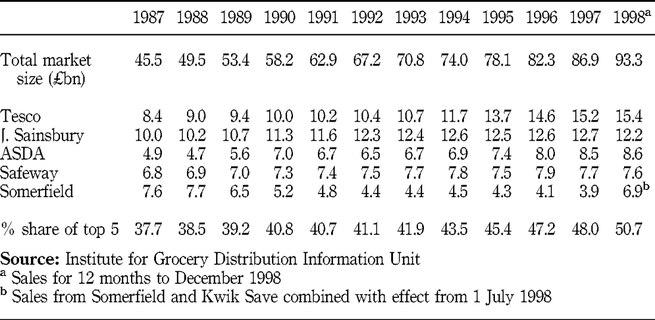
As with other sectors and industries, the grocery retail market has seen a massive degree of consolidation, with a small number of companies growing in size to gain increasing shares of the market. There are a huge number of superstores of different formats operated by the various retail chains, and a small share remaining for independent businesses and small shops. These smaller businesses have been closing at accelerating rates over the past few decades. The following table shows the trend of increasing market share for supermarkets and declining market for small independent retailers.
In the early 20th century the idea of large retail units in the UK selling a range of different grocery products began to develop. Tesco opened its first store in Burnt Oak, North London in 1929. Sainsbury’s began expanding from it dairy products into other product types in the 1920s. In 1930 Marks and Spencer opened its flagship store in Marble Arch, London.
After the Second World War agricultural subsidies and retail liberalisation created the climate for the growth of the supermarkets. Greater wealth provided the conditions for supermarket growth. The first retailer to open a self-service format at one of its stores was Marks and Spencer, who trialled it at its store in Wood Green, North London, which opened in 1948. In 1950, Sainsbury's followed, opening a self-service store in Croyden. All the major supermarkets of the UK opened self service stores in the 1950s with ASDA following suite in 1963, in Castleford, Yorkshire.
Supermarket chains began growing rapidly, spreading to become national chains through the 1960s and building larger stores selling larger product ranges. The conditions for their growth continued. More efficient transport systems reduced costs and this allowed for cheaper global sourcing. Consumer wealth allowed for more ubiquitous car use. As a consequence the “one-stop shop” of supermarket shopping grew in popularity. Relaxed planning regulation allowed for the growth of retailers into out-of-town sites in the 1970s and 1980s. This brought about huge changes in retail and led the way for supermarket dominance over the food retail market.
More recently the major UK chains have been opening ever-larger format stores, with Asda and Tesco in particular opening hypermarkets. At the same time Tesco and Sainsbury’s have diversified into smaller format convenience stores to try to gain a growing share of an increasing consumer trend towards convenience “top-up” shopping.
As with other sectors and industries, the grocery retail market has seen a massive degree of consolidation, with a small number of companies growing in size to gain increasing shares of the market. There are a huge number of superstores of different formats operated by the various retail chains, and a small share remaining for independent businesses and small shops. These smaller businesses have been closing at accelerating rates over the past few decades. The following table shows the trend of increasing market share for supermarkets and declining market for small independent retailers.
The following video based on food miles features Mike Murry from Marks and Spencer who explains the role of Marks and Spencer in the sudden growth of supermarkets in the UK.
A central aspect of the development of the new superstore food retail is that of its provision for a society of income dispersion. The large retail outlets organise and integrate many previously separate channels of consumer demand. They bring together high income consumers with low income consumers, so creating their own internal niche markets with distinctive marques at high prices, together with their own-label discount ranges. Within this range of niche markets supermarkets have developed organic and bio-ranges, fair trade, local produce and health food ranges such as foods that are rich in phytonutrients and antioxidants. In many ways supermarkets enjoy quasi-monopoly conditions within these niche markets. However due to the success of such niche markets as organic food and to some extent fair trade we are now seeing larger superstore retailing in these sectors. Fair trade, particularly Oxfam are increasing in size and retail an increasingly broad range of food items. Bio/orgainc supermarkets are on the increase in Europe and the USA as an increasingly affluent middle income group seek to separate their demand from the perceived aggressive and exploitive business model of conventional supermarkets.
Hier klikken om te bewerken.
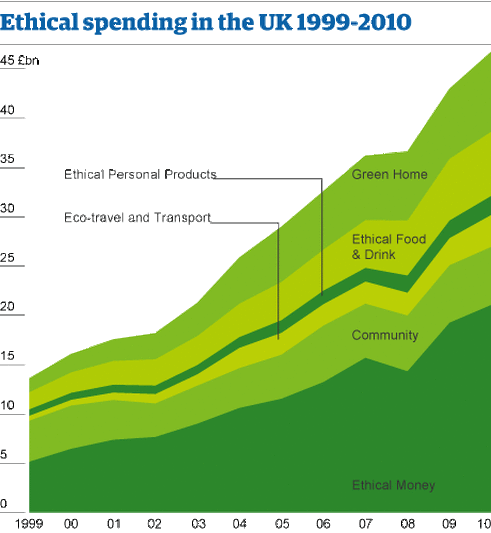
The graphic to the left produced by the Co-operative in 2011 shows the rapid growth in ethical consumption. Within it ethical food and drink is showing a steady rate of increase since 1999 along with other ethical choices. As part of this a report from the Co-operative stated that organic food peaked in value in 2008 at £2 billion; but since then has seen declined and in 2010 was valued at £1.56 billion. The growing niche within ethical food and drinks is fair trade, which recorded a rise of more than a third (36%) in 2010 and sales of fish from sustainable sources grew by 16.3% in the same year.
A whole range of ethical food markets has developed. One part of the ethical food industry is local organic food markets. Local food campaigners led by civic society groups champion the idea of consuming local foods, normally produced within a 100 kilometer or mile radius of your home. An example of how this is organised can be seen in farmer's markets. Farmer markets act as small organised co-operatives, whereby there is shared costs of rental space for frequent local farmer markets. Farmer's markets enable the farmer to go directly to the consumer. In this way farmers can sell premium food at higher value. Ethical consumers enjoy the benefits of supporting their local economy with the added benefits of consuming fresh healthy food with limited carbon footprint or food miles associated with it. Larger retailers including highstreet shops and supermarkets are realising the niche market qualities of local food. As a result we are seeing an increasingly larger range of local and artisan food and drink products on the highstreet. This has grown to such an extent that local food and drink produce can be used to reimage places and cities. This is shown in the video below the reimages Brussels as sustainable city:
A whole range of ethical food markets has developed. One part of the ethical food industry is local organic food markets. Local food campaigners led by civic society groups champion the idea of consuming local foods, normally produced within a 100 kilometer or mile radius of your home. An example of how this is organised can be seen in farmer's markets. Farmer markets act as small organised co-operatives, whereby there is shared costs of rental space for frequent local farmer markets. Farmer's markets enable the farmer to go directly to the consumer. In this way farmers can sell premium food at higher value. Ethical consumers enjoy the benefits of supporting their local economy with the added benefits of consuming fresh healthy food with limited carbon footprint or food miles associated with it. Larger retailers including highstreet shops and supermarkets are realising the niche market qualities of local food. As a result we are seeing an increasingly larger range of local and artisan food and drink products on the highstreet. This has grown to such an extent that local food and drink produce can be used to reimage places and cities. This is shown in the video below the reimages Brussels as sustainable city:
|
|
Hier klikken om te bewerken.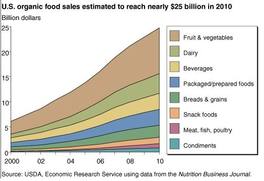 Source: USDA
In the graphic to the left provided by USDA we can see that the market size for organic produce in the USA hit $25 billion in 2010. The largest contributor, more than doubling in the decade was fruit and vegetables. Other large growing markets are organic dairy and beverages.
|
